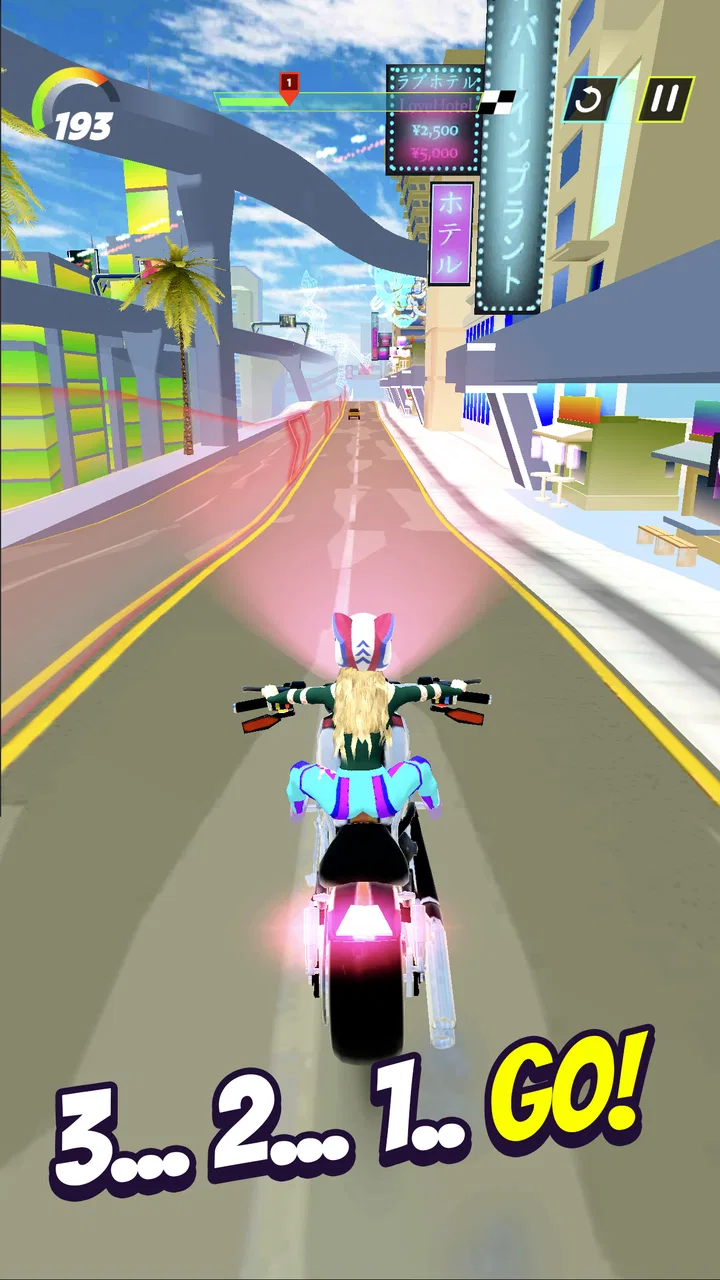
Wild Wheels: Bike Racing
- 4.5
- Rating
- 10.00M
- Installs
- Free
- Price

 Analysis by App-foxy
I found Wild Wheels: Bike Racing most interesting as a quick, uncomplicated racing game rather than as a deep motorcycle simulator. It is built around the immediate appeal of revving a bike, handling a short race, and trying to reach the finish without losing control. That focus makes it easy to understand, but it also means the experience depends heavily on whether you enjoy brief bursts of action more than long-term tuning, realistic physics, or a large competitive structure.
In my experience, the game is easiest to appreciate when I treat it as something to pick up between other tasks. It works well for a short break, a commute, or a few minutes when I want a racing challenge without first learning a complicated control system. The game is free to download, and SayGames Ltd is the developer behind it. Its age rating is Everyone 10+, so it is aimed at a broad audience while still presenting racing action that may be more suitable for older children and adults than for very young players.
The reception also suggests that it has reached a substantial audience: the game has an average rating of 4.5 from around 93 thousand ratings and more than 10 million installs. I would not treat those figures as a guarantee that every player will enjoy it, but they do indicate that its simple racing concept has found plenty of interest. The current version is 1.1.18, and it runs on Android 8.0 or later.
You May Also Like

 Blood Strike: 2.5 Anniversary
Blood Strike’s Loadouts Turn Every Drop Into a Tactical Gamble
A close look at Blood Strike’s custom loadouts: how fast access to signature weapons reshapes its battle royale rhythm, rewards preparation, and narrows the gap between fights.

 Pandora - Music & Podcasts
Pandora’s Music Is Easy to Start, but Harder to Recover
Pandora’s strength is its low-effort path from a seed to a station. Its weak spot is how much confidence it asks you to place in connection, setup, and quiet recovery.

 8 Ball Pool
 Is Built on Rivalries, Rematches, and Routine
A close look at the rivalries, rematches, shared routines, and unanswered safety questions that turn a quick pool match into a persistent mobile community.

 Samsung Music
’s Quiet Strength Is Playing What You Already Own
Its reach comes less from spectacle than from dependable access to a personal library. That simplicity is both the app’s strongest retention engine and its ceiling.

 AccuWeather: Weather Radar
AccuWeather Review: A Quick, Clear Forecast for Everyday Decisions
For everyday plans, the best forecast is the one you can understand quickly. AccuWeather makes rain timing, radar, and local conditions easy to act on, with a few trade-offs.

 Hill Climb Racing
Why Hill Climb Racing Still Turns Crashes Into One More Run
A tiny car, a bumpy hill and one more upgrade: Hill Climb Racing keeps resurfacing because its simple chaos makes every near-miss feel personal.
More From Our News Desk



How clearly the game presents racing information
The strongest part of the design is its directness. Wild Wheels: Bike Racing does not need a long explanation before the central idea becomes clear. You are there to control a bike, maintain momentum, and complete the course. That kind of straightforward structure helps players who do not want to study menus, upgrade trees, or technical racing terminology before starting.
For me, readability in a racing game is less about having lots of text and more about understanding what deserves attention while moving. A good session should make the important information obvious: where the bike is going, what kind of obstacle is ahead, and when a mistake has changed the outcome. This game benefits from its focused presentation because there is less competing information than in a full racing package with several layers of statistics and customization.
That simplicity is useful for newcomers. Someone who rarely plays racing games can approach it without feeling that they are already behind experienced players. I could imagine handing the phone to a friend who normally avoids racing games and having them understand the basic objective quickly. The learning curve feels more connected to timing and control than to memorizing a complex interface.
There is a trade-off, though. Players who prefer detailed race information may find the experience too light. Traditional racing alternatives often provide multiple camera views, vehicle statistics, extensive settings, and a more elaborate explanation of track conditions. Wild Wheels instead puts the emphasis on the immediate ride. That keeps the screen cleaner, but it can make the game feel less informative for anyone who wants to analyze every part of a race.
Navigation that suits short sessions
The game is particularly comfortable for people who want to open it and get moving quickly. I do not need to reserve a large block of time to make progress in the moment. That makes it a practical choice when I have only a few minutes, such as waiting for an appointment or taking a short break from work.
A useful habit is to play the first attempt of a session as a reading run instead of immediately chasing a perfect result. I pay attention to how the bike responds, where the course begins to demand more careful timing, and whether my first mistake came from moving too early or reacting too late. This approach makes the simple controls feel more deliberate and avoids wasting attempts through hurried corrections.
The game’s compact style may also help players who become overwhelmed by large game menus. There is less pressure to compare a long list of bikes or master a complicated garage before enjoying the core activity. On the other hand, anyone looking for a detailed career mode or a serious simulation-style progression system should consider a more ambitious racing game instead.
Motor control, sound, and sensory comfort
Racing games ask for fast visual decisions, but they also place demands on hand control. In Wild Wheels, the main challenge is keeping attention on the moving bike while responding at the right moment. That can feel satisfying when my actions line up with the course, yet it can become tiring if I am already dealing with shaky hands, limited precision, or difficulty sustaining concentration.
I found that the best way to approach the game is with small, intentional inputs rather than frantic movements. Overcorrecting is a common source of trouble in any fast bike game, and the temptation to react dramatically can make a difficult section worse. A calmer grip and a steady rhythm are more useful than trying to force every turn or obstacle.
This is one of the less obvious strengths of the game: its simple premise leaves room to build a personal control routine. I can use a short warm-up attempt to decide whether the screen feels comfortable that day. If my hands are tired, I can stop after a few tries rather than treating every session as a test of endurance. That makes the game easier to fit around real life, even though it does not remove the physical demands of touch-based racing.
Sensory comfort is more individual. Fast movement, engine-focused action, and repeated attempts may be enjoyable for one player and tiring for another. I would recommend lowering the phone’s general media volume or playing without sound if the engine noise becomes distracting. The game remains understandable as a visual racing experience, but sound can contribute to the feeling of speed, so removing it may make the ride feel less lively for players who enjoy audio feedback.
Players who need adjustable text size, high-contrast controls, remappable inputs, or specialist accessibility settings should check the game directly on their device before committing to regular play. I would not choose it on the assumption that it can accommodate every motor or sensory need. Its accessible quality comes mainly from its straightforward concept, not from a broad set of confirmed customization tools.
Who benefits from the control style
This game is a good match for players who enjoy learning through repetition. I get more from it when I accept that an unsuccessful run is useful information rather than a wasted attempt. That mindset is especially helpful for younger players within the age rating, casual players, and anyone who likes a small challenge that can be retried immediately.
It is less suitable for someone who wants slow, predictable movement. If quick reactions cause discomfort or frustration, a turn-based racing game, a management-focused title, or a racing game with extensive control options may be a better choice. Wild Wheels does not need to be difficult for everyone, but its appeal depends on the feeling of active control and momentum.
Playing in different everyday situations
Where and when I play changes how much I enjoy the game. At home, with both hands free and a stable posture, I can concentrate on improving my timing. In a noisy waiting room, I may prefer to mute the sound and play only a few attempts. On public transport, sudden movement and limited hand space can make a fast racing game less comfortable than it is on a sofa or desk.
A realistic use case is a ten-minute break during a busy day. I can start a session, make several attempts, and put the phone away without needing to remember a complicated storyline or a long chain of objectives. That is where the game feels most natural to me. It gives the break a clear beginning and end instead of encouraging me to settle into a long campaign.
It can also work as a casual shared activity. I would not present it as a full local multiplayer replacement, but it can still be fun to let another person try a course and compare how each of us handles the same kind of challenge. The simple premise makes it easy to explain, which is useful when introducing the game to someone who is not a regular mobile gamer.
For children, the Everyone 10+ rating is an important part of the decision. Parents should still consider the child’s comfort with fast action and the presence of in-app purchases. The purchase option is listed at $2.49 per item, so I would use the device’s purchase protections if a child may play without supervision. The game is free to start, but “free” does not mean that every optional part of the experience is automatically outside the spending conversation.
The game is also convenient for Android users with older supported phones because the minimum operating system is Android 8.0. That does not tell me how every device will perform, so I would still pay attention to heat, battery use, and responsiveness during a longer session. A racing game feels much less enjoyable when the phone is uncomfortable to hold or the controls stop feeling immediate.
Where the experience still creates barriers
The biggest barrier is the narrow focus. Wild Wheels is built around fast bike racing, so players who need a slower pace may not find enough flexibility. There is value in a game that knows what it wants to be, but that clarity also limits the number of ways to engage with it. I cannot turn a short action racer into a relaxed exploration game simply by changing my approach.
Another limitation is the likely difference between casual enjoyment and long-term commitment. I can see myself returning for brief sessions, especially when I want a quick challenge, but players who need a rich sense of progression may eventually want more. Conventional racing alternatives often offer larger vehicle collections, detailed upgrades, championships, or simulation-oriented handling. Those features can make a game feel more rewarding over weeks, while Wild Wheels is more immediately approachable.
In-app purchases are another point to consider carefully. At $2.49 per item, individual purchases may appear modest, but repeated optional spending can change the cost of a free game. I would decide in advance whether I am happy to play without buying anything and keep that boundary clear. This is especially important when the game is installed on a shared family device.
There is also the issue of attention. A fast bike game may not be a good choice for someone who needs a visually quiet experience or who becomes uncomfortable with repeated motion. I would avoid playing it when I am tired enough to make careless movements, because the resulting frustration can outweigh the entertainment. A slower puzzle or strategy game would be more suitable in that situation.
For players with specific accessibility requirements, the safest approach is practical rather than optimistic: test the controls, observe whether the screen remains comfortable, and decide whether the game can be used without strain. The basic design is easier to understand than many complex racers, but easy-to-understand is not the same as universally accessible. That distinction matters, particularly for players who depend on adjustable controls or visual customization.
My inclusive verdict on the ride
I recommend Wild Wheels: Bike Racing to people who want a free, approachable racing game that can fill short gaps in the day. Its clearest advantage is that it gets to the action without demanding the commitment of a large racing simulation. SayGames Ltd has aimed at a compact experience, and that makes it welcoming to newcomers who might be put off by detailed garages, technical tuning, or lengthy career systems.
The game is also a reasonable option for players who enjoy improving through repeated attempts. My practical advice is to begin with short sessions, keep movements controlled, mute the audio if the engine sound becomes tiring, and avoid playing in situations where the phone is difficult to hold steadily. Those small choices make the experience more comfortable and help separate a genuine control problem from a problem caused by an awkward playing environment.
I would skip it if my priority were realistic motorcycle handling, a deep progression system, extensive accessibility customization, or a substantial competitive structure. In those cases, a more feature-rich racing alternative is likely to offer better value, even if it takes longer to learn. I would also be cautious about recommending it to someone who is sensitive to fast movement or who needs guaranteed support for particular motor or sensory requirements.
For the right player, however, the simplicity is the point. The game has a 4.5 average rating, more than 10 million installs, and a large enough audience to show that its quick racing formula connects with many mobile players. My final view is that it works best as an easy-to-start action game, not as a replacement for a full racing hobby. If you want a short, readable bike-racing challenge with little preparation, it is worth trying; if you need depth or extensive control flexibility, look elsewhere.
FAQs for Wild Wheels: Bike Racing
01What is Wild Wheels: Bike Racing?
Wild Wheels: Bike Racing is an adrenaline-pumping mobile game designed for both Android and iOS. It offers players the chance to race through diverse terrains, execute thrilling stunts, and compete against other players. The game combines realistic physics with engaging graphics for an immersive racing experience.
02Is Wild Wheels: Bike Racing free to play?
Yes, Wild Wheels: Bike Racing is free to download and play. However, it includes optional in-app purchases that can enhance the gaming experience. Players can buy additional bikes, customization options, or power-ups, but these purchases are not necessary to enjoy the game fully.
03What are the system requirements for Wild Wheels: Bike Racing?
For Android users, Wild Wheels: Bike Racing requires Android 5.0 and up. iOS users need iOS 11.0 or later. The game is compatible with most modern devices, but players should ensure they have sufficient storage space and a stable internet connection for optimal performance.
04Can I play Wild Wheels: Bike Racing offline?
Wild Wheels: Bike Racing offers limited offline playability. While you can enjoy single-player modes without an internet connection, accessing multiplayer races or downloading additional content requires being online. To experience the full range of features, playing with an active internet connection is recommended.
05How can I customize my bike in Wild Wheels: Bike Racing?
Customization in Wild Wheels: Bike Racing is both extensive and user-friendly. Players can modify their bikes by changing colors, upgrading parts for better performance, and adding unique decals. Customization options are either unlockable through gameplay achievements or available for purchase via in-app transactions.
Pros
- Stunning graphics enhance the racing experience.
- Variety of bikes to customize and upgrade.
- Smooth controls for intuitive gameplay.
- Engaging multiplayer mode for competitive fun.
- Regular updates add fresh content and challenges.
Cons
- In-app purchases can be quite expensive.
- Occasional lag in multiplayer matches.
- Limited offline content availability.
- Battery consumption is relatively high.
- Some ads are intrusive during gameplay.

Wild Wheels: Bike Racing
Gallery